The Empty Chair: Getting Through the First Holidays After a Loss
I’m not a therapist, a counselor or a doctor, and this is general information. If grief has you thinking about not wanting to be here, call or text 988, the Suicide & Crisis Lifeline, any time of day. If the weight hasn’t lifted after many months, tell your doctor. It’s a health question, and it’s treated like one.
It usually doesn’t start on the holiday itself. It starts in the grocery store.
You reach for the cranberry sauce, the kind from the can, the kind only he liked. Or someone at church asks, kindly, “Are you doing Thanksgiving at your place this year?” And you realize you haven’t let yourself think about it.
Thanksgiving is Thursday, November 26. If this is the first one, or even the second, without someone who always had a seat at the table, you may already feel it coming.
That feeling isn’t weakness, and it isn’t a sign you’re grieving wrong. It’s predictable, and something predictable can be planned for.
Why the holidays hit harder
Grief counselors have a name for it: an anniversary reaction. Holidays, birthdays and the date of the death can bring back the raw, early grief you thought was behind you.
It can last longer than people expect. In a study of widows and widowers, Carnelley, Wortman and colleagues found that anniversary reactions can still happen seven to eight years after a spouse’s death, sometimes fairly intense, often lasting a few hours or less.
The honest limit: I’m reporting that study as summarized by a hospice’s grief team, not from the paper itself. But it matches what hospice workers and families describe, and it fits the experience of almost anyone who has buried someone they loved.
So if a wave hits on the fourth Thursday in November, it isn’t a setback. It’s the calendar doing what calendars do.
What’s normal, and what the research actually shows
Many people grieve hard and still keep their footing. Researchers George Bonanno, Camille Wortman and Randolph Nesse followed 185 older adults who lost a spouse, with an average age of about 69, and sorted them by how they fared over time.
About 46 percent were resilient. They were sad, they missed their spouse, and they kept functioning: sleeping, eating, seeing people. Another group, about 16 percent, had chronic grief that stayed heavy.
The limit: one study, in one metropolitan area, mostly women. It doesn’t predict how you will do. What it does show is that there isn’t one right way to grieve, which is also what the National Institute on Aging tells families: “There is no right or wrong way to mourn.”
If you’re doing better than you expected, you’re not cold. If you’re doing worse than you expected, you’re not broken.
When grief gets stuck
There is a point where grief stops being only grief. In 2021 the American Psychiatric Association announced that prolonged grief disorder was being added to its diagnostic manual. For adults, it applies only when the death was at least 12 months ago, and the symptoms are intense: feeling part of yourself has died, deep loneliness, feeling that life has no meaning, being unable to pick back up your friendships or plans.
The APA’s president at the time put the line well: “Grief in these circumstances is normal, but not at certain levels and not most of the day, nearly every day for months.”
How common is it? A 2017 analysis of 14 studies, cited in a later review, put it at about 1 in 10 bereaved adults after a non-violent death. Most people are in the other nine.
Your body grieves too. In a study that followed more than 12,000 married adults over 50, the odds of dying were highest in the first three months after a spouse’s death. The effect was clearest for men; for women in that study it wasn’t statistically significant. It’s an association, not proof that grief itself causes harm. But it’s reason enough to keep your own doctor’s appointments this winter.
“I’d rather just skip it this year”
This is the objection I hear most, and I want to take it seriously, because sometimes it’s right.
Skipping is a legitimate choice. You don’t owe anyone a performance of being fine. But a skip that isn’t planned can turn into a long, silent day alone in a quiet house, and that’s usually the hardest version.
You have three real options:
Keep it. Same house, same table, same menu.
Change it. Same people, different shape. A restaurant. Someone else’s house. Dinner instead of lunch. A new dish in place of the one that was always theirs.
Skip it, with a plan. A movie, a drive, a walk, a volunteer shift, with one person who knows where you are and will call that evening.
My pick
For a first holiday after a loss, I’d change it. Here’s the order and why.
First: change it. You keep the people, who are the main thing a holiday is for, and you take away some of the exact moments that will ambush you: the same chair, the same carving knife, the same time on the clock.
Second: skip it with a plan. Better than forcing a full holiday you dread. Worse than change, because it can leave you alone at the hours that tend to be hardest.
Third: keep it exactly the same. It works for some people. For many, it’s the version with the most landmines.
The strongest argument against my pick, left standing: for some families, the sameness is the comfort. Making her stuffing exactly the way she made it, at her table, is how they keep her in the room. If that’s your family, and everyone knows what they’re walking into, keeping it may be the right call. You know your people better than any study does.
Give the empty chair a job, and it stops being the only thing in the room.
Give the empty chair a job
Whatever you choose, plan the hard moments before they arrive.
Decide in advance and say it out loud. Tell your family by this weekend which version you’re doing. Uncertainty is its own stress.
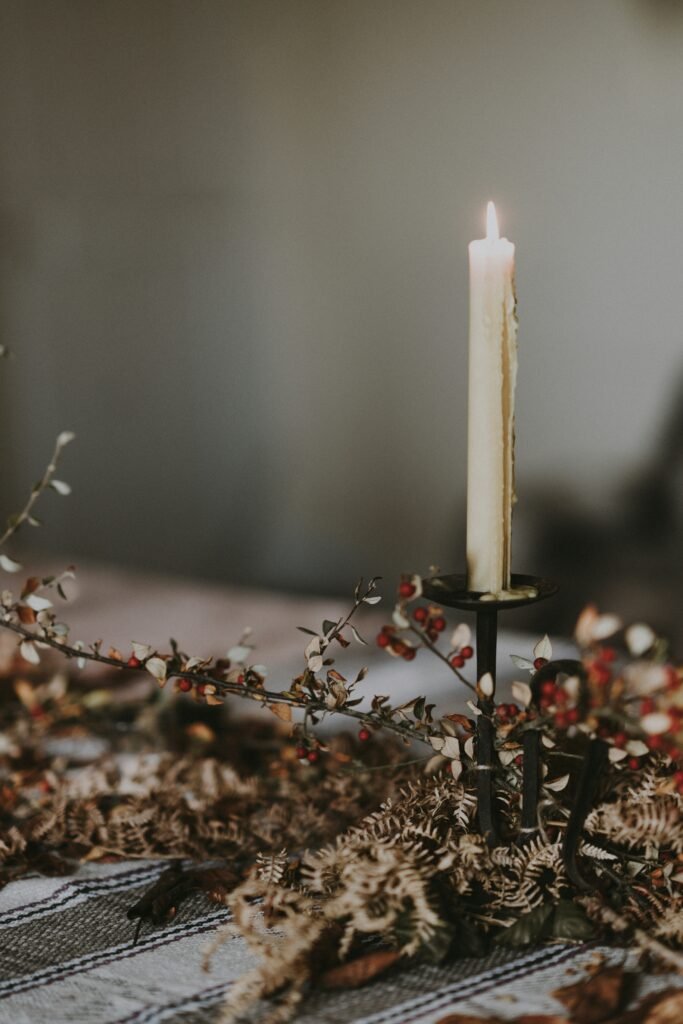
Give the empty chair a job. Light a candle at their place. Go around the table and have each person tell one short story about them. Make their dish and say whose it was. When you name the loss on purpose, it stops sitting in the room unspoken. There’s more on rituals that hold the people we’ve lost in Memories and Rituals.
Hand off their jobs. Who carved? Who said grace? Who called the cousins? Assign those before the day, so nobody freezes in front of the turkey.
Build an exit. Drive yourself. Agree with one person that if you step outside for a walk, they’ll let you go and won’t follow unless you want them to.
Plan the hours around the meal. The morning and the evening are often harder than dinner itself. Put something in both: a phone call at eight, a walk at ten.
Tell your family what you need
Your children and grandchildren want to help. Most of them have no idea how.
So tell them, plainly. “I want to be there. I may need to step out. If I do, let me go.” And this one, which matters more than people realize: “You can say his name. I want you to.”
A lot of families go quiet about the person who died because they’re afraid of making it worse. Giving them permission is one of the kindest things you can do for everyone at the table, including you.
Help that’s already paid for
If the person you lost was in hospice care, here’s something many families never use. Federal rules require a Medicare-certified hospice to make bereavement services available to the family for up to a year after the death.
Depending on the hospice, that can mean a call from a counselor, a support group or a check-in around the holidays. Call and ask what they offer.
The National Institute on Aging also points to grief support groups, some general and some for specific losses. Your place of worship, senior center or hospital may host one.
If you’re the one who isn’t grieving
Maybe it’s your friend, your sister, your neighbor. Invite them now, specifically, with an easy out: “We’d love to have you Thursday. If it’s too much, I’ll bring you a plate Friday.”
Then call the week after. The calls dry up after the funeral, and they dry up again after the holidays. Be the one who calls. That idea is the whole heart of last Monday’s piece on friendships, and it matters most right here.
What to do this week
- Decide: keep it, change it or skip it with a plan. Tell one person by Sunday.
- Give the empty chair a job. A candle, a story round, their dish with their name on it.
- Plan the morning and the evening, not just the meal.
- If hospice was involved, call them and ask what bereavement support they offer.
- Keep your own appointments. If you’ve let your health slide since the loss, book a checkup.
- If someone you know is grieving, invite them today, and put a reminder to call them the week after.
Grief is the cost of having loved someone well. You don’t have to pay all of it on one Thursday in November. Plan the day, name the person, and let the people who love you help carry it.
Go be bold!
Tell me how your family remembers someone at the holiday table. A candle, a recipe, a toast, a story. Reply and share it. With your permission, I’ll pass a few along, without names, before Thanksgiving, so another family can borrow one.
Sources
- National Institute on Aging — Coping With Grief and Loss — “no right or wrong way to mourn,” and support groups
- American Psychiatric Association — Understanding Prolonged Grief Disorder (2021) — the 12-month threshold, symptoms and the APA president’s quote
- Bonanno, Wortman & Nesse — Prospective Patterns of Resilience and Maladjustment During Widowhood (2004) — 185 widowed older adults; about 46% resilient
- Hospice Chesapeake — Anniversary reactions: The science behind holiday grief — anniversary reactions up to seven or eight years after a spouse’s death
- European Journal of Psychotraumatology — review of prolonged grief disorder (2019) — about 1 in 10 bereaved adults after a non-violent death
- Moon et al. — Widowhood and mortality in the United States (2014) — highest risk in the first three months, clearest for men
- 42 CFR § 418.64 (Cornell LII) — hospice bereavement services for up to a year
- 988 Suicide & Crisis Lifeline — call or text 988, any time