The Drive Home Got Darker
I’m not an eye doctor, and this isn’t medical advice. If your vision has changed — especially at night, or around bright lights — the first step is an exam with an optometrist or ophthalmologist, not an article.
Four weeks from yesterday, on Sunday, November 1, the clocks fall back an hour. The drive home from supper, from Wednesday night service, from your grandson’s game — the one you’ve made in daylight all summer — is about to happen in the dark.
And if you’re like a great many people over 60, you’ve already noticed something you haven’t quite said out loud. Oncoming headlights feel like someone is aiming them at you. The lane lines seem to fade a little earlier than they used to. You find yourself slowing down on roads you’ve driven for thirty years, and you’ve started, without ever deciding to, turning down invitations that end after sunset.
When somebody asks, you say: I just don’t like driving at night.
I want to push on that sentence, the same way we pushed on “I’m just a light sleeper” and “everybody mumbles now.” Because like those, it sounds like a preference. Usually it’s a symptom. And a symptom can be looked at.
Your eyes need more light than they used to — a lot more
Here is the plainest fact in this article. According to AAA, by age 60 your eyes need about three times as much light to see as they did at 20. The pupil gets smaller with age and doesn’t open as wide in the dark, so less light reaches the back of the eye to begin with.
Three times. Same road, same headlights, same streetlights — and a third of the light arriving.
The National Safety Council puts the earlier stages of it this way: a 50-year-old may need twice the light a 30-year-old needs to see equally well. It doesn’t arrive all at once. It arrives a little each year, which is exactly why nobody notices until the drive home starts to feel like work.
Why it matters more than it feels like it does
The National Safety Council has a number I’d ask you to read twice: we do only about a quarter of our driving at night, but about half of traffic deaths happen at night.
Darkness compresses everything. Low beams light roughly 250 feet ahead of you, according to the NSC — high beams about 500. At highway speed, 250 feet goes by very fast. Depth perception, color recognition and peripheral vision all get worse in the dark, for everybody, at every age. Add a pupil that lets in a third of the light, and the margin you used to have simply isn’t there anymore.
None of that is a reason to hand over the keys. It’s a reason to stop treating the problem as a mood.
Same road, same headlights — and a third of the light arriving.
The thing to rule out first: cataracts
If headlights have started to look like starbursts, if you’re seeing halos around streetlights, or if colors look a little washed out, the conversation you need to have is about cataracts.
The National Eye Institute lists exactly those symptoms — trouble seeing at night, lamps and headlights that seem too bright, halos around lights, colors that look faded — and it adds a fact most people don’t know: more than half of Americans 80 and older either have cataracts or have already had them removed. They develop slowly, so the person who has them is often the last to notice.
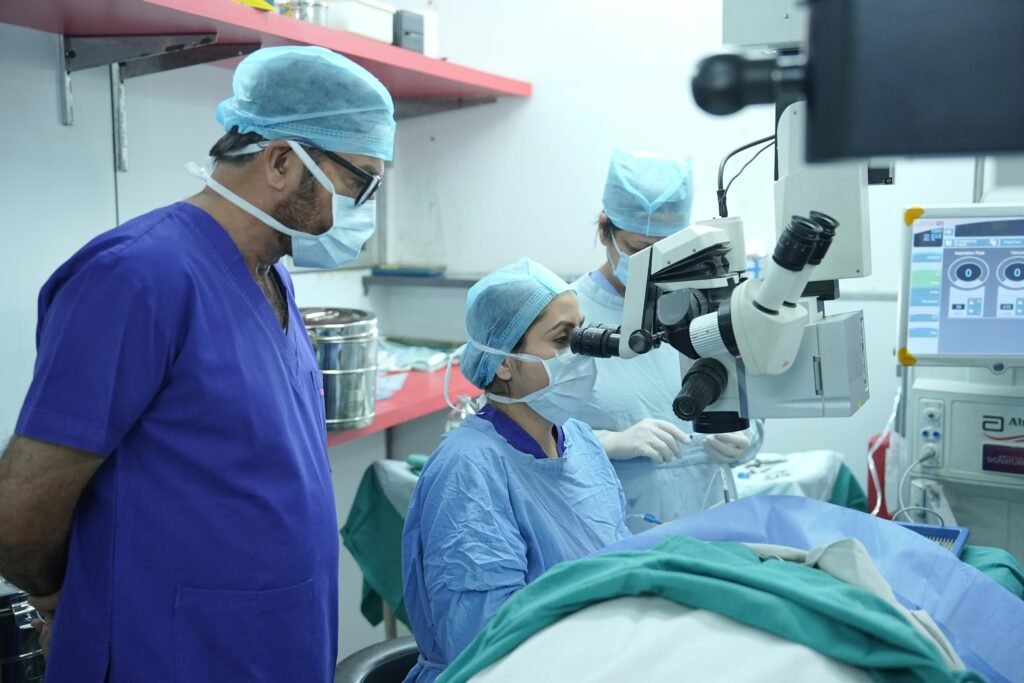
Here’s the good news, and it’s very good: the NEI calls cataract surgery very safe, and says nine out of ten people who have it see better afterward. A great many people who “stopped liking” night driving find, after surgery, that they like it fine.
So the first assignment isn’t a gadget. It’s an eye exam — and when you go, say the words night driving and glare to the doctor specifically. Don’t wait for them to ask.
Save your money on the yellow glasses
You’ve seen the ads. Yellow-tinted “night driving glasses,” usually with a testimonial from someone who swears everything looks brighter.
It does look brighter. That’s the trap.
Researchers at the Schepens Eye Institute put drivers in a simulator at night, with oncoming headlight glare, and measured how quickly they spotted pedestrians wearing clear lenses versus three different yellow lenses. As the American Academy of Ophthalmology summarized it: lens color made no difference to how fast people saw the pedestrian. The yellow lenses felt brighter. They didn’t help anybody see. A tinted lens, if anything, removes light — and light is the one thing you’re already short of.
What does help, according to the NSC, is an anti-reflective coating on your regular prescription glasses. It cuts the reflections that turn every oncoming car into a smear. If you’re due for new lenses anyway, ask for it.
The car is half the problem
This is the part almost nobody checks, and it’s the cheapest to fix.
The inside of your windshield. It builds up a film you can’t see in daylight — and then every oncoming headlight lights it up like frosted glass. Clean the inside, not just the outside. You’ll be startled.
Your headlight lenses. If the plastic covers on your headlights have gone yellow or cloudy, you’re losing a real share of your own light before it reaches the road. Restoration kits are inexpensive, and most shops will do it for you. While you’re there, ask them to check the aim.
Your dashboard. Turn the brightness down. A bright dash makes your pupils close down further — the opposite of what you need.
Your high beams. Use them. The Insurance Institute for Highway Safety watched real drivers on dark roads and found that only 18 percent of drivers with no one in front of them had their high beams on — even though most of them told surveyors they used high beams most of the time. Whenever the road ahead is empty, put them up. It doubles what you can see.
When the glare comes, the NSC’s advice is the old instructor’s trick: drop your eyes to the white line on the right edge of the road and steer by it until the car passes. Don’t stare into the lights. You can’t win that one.
Plan the drive like it matters
I’ve spent most of my life teaching self-defense, and the first thing I teach isn’t a technique. It’s planning: knowing your route, knowing your exits, choosing the path that doesn’t put you in the hard spot to begin with. The best fight is the one you planned your way around.
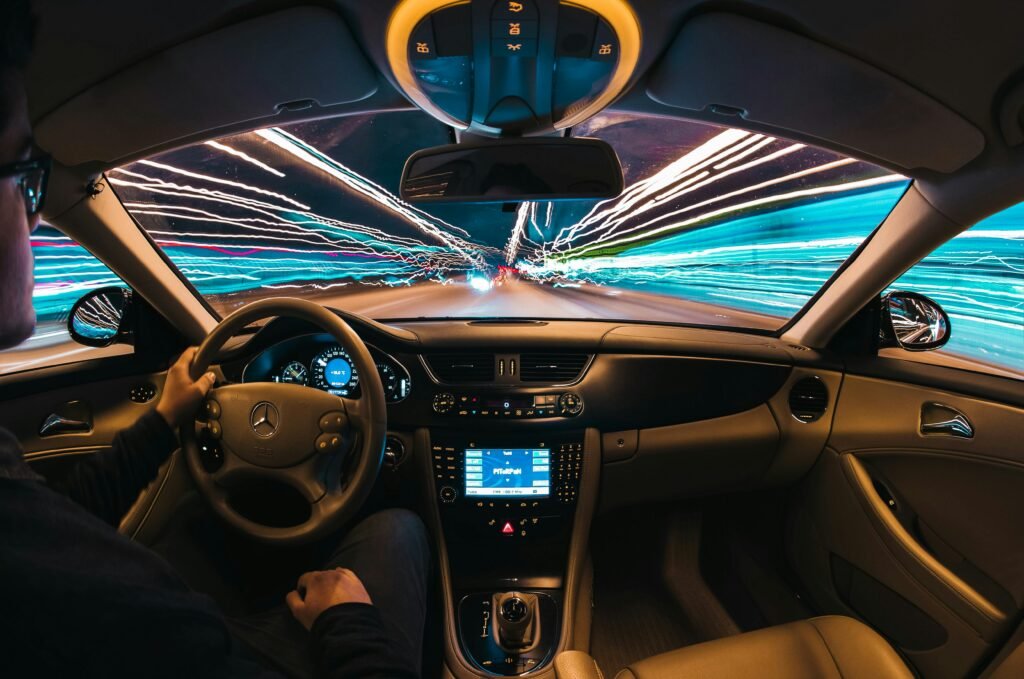
Night driving works the same way.
Pick the route that’s familiar and well lit, even if it’s six minutes longer. Leave a little earlier so you’re not hurrying. Slow down — not to a crawl, but enough that what you can see matches how fast you’re going. If it’s raining hard and dark both, that’s a night to get a ride, and there’s no shame in it at all.
And if, after the eye exam and the clean windshield and the high beams, the dark still feels like too much — then cutting back on night driving isn’t giving up. It’s a decision. There’s a difference between choosing not to and not being able to, and the first one keeps you in charge.
What to do before November 1
- Book an eye exam this month. Say “night driving” and “glare” out loud to the doctor.
- Clean the inside of your windshield this weekend.
- Look at your headlight lenses in daylight. Cloudy or yellow? Get them restored and aimed.
- Turn the dashboard lights down and leave them there.
- Use your high beams every time the road ahead is empty.
- Skip the yellow glasses. Ask about anti-reflective coating instead.
- Drive your regular after-dark route once before the clocks change, at the time you’ll actually be driving it, on purpose, when nothing’s riding on it.
You’ve been told that this is just what happens. Part of it is. But a surprising amount of it is a dirty windshield, a cloudy lens, a switch you forgot you had, and an eye exam you’ve been putting off.
Fix those first. Then decide.
Go be bold!
Tell me what changed first. Has night driving gotten harder for you, or for someone you love? Reply and tell me which went first — the glare, the lane lines, or the nerve. And if you’ve had cataract surgery, tell the rest of us what the drive home looked like afterward.
Sources
- AAA — How eyesight affects driving — by 60, eyes need about three times the light they did at 20
- National Safety Council — Driving at Night — a quarter of driving, half of deaths; low vs. high beam distance; anti-reflective lenses; the right-edge line
- National Eye Institute — Cataracts — symptoms; prevalence at 80+; 9 in 10 see better after surgery
- American Academy of Ophthalmology — No evidence to support yellow-lens night-driving glasses — the simulator study
- IIHS — Few drivers use their high beams — the 18 percent figure