The Envelope You’re About to Throw Away
A note before we start. I’m not an insurance agent and I don’t sell plans. Nothing here is a recommendation to buy or drop any particular coverage — your situation, your medications and your doctors decide that. This is about the calendar and the questions worth asking. Free, unbiased help exists, and I’ll tell you exactly where to find it at the end.
Sometime in the next three weeks, a thick envelope is going to land in your mailbox from your Medicare plan.
It will not look important. It will look like the fourth piece of insurance mail you’ve gotten this month, printed in a typeface chosen by someone who has never met a human being. Somewhere on it will be words like Annual Notice of Change, and inside will be twenty or thirty pages of tables.
Most people give it about four seconds and a wrist flick into the recycling.
I want to make the case that those four seconds are the most expensive of your year.
What that envelope actually is
Every Medicare Advantage and Part D drug plan is required to send it to you by September 30. It’s not marketing. It’s a legal notice, and it has exactly one job: to tell you every way your plan is going to be different on January 1.
Your premium. Your deductible. Your copays. Which pharmacies count as “in network.” Which doctors are still in the network. And the big one, the one that quietly does the most damage: which drugs the plan still covers, and on what tier.
Here’s the part that catches people. A plan can change all of that, and you stay enrolled automatically unless you act. Nobody calls. Nobody asks whether the new version still works for you. The default is that you’re rolled into next year’s plan whatever it now says, and you find out in February at the pharmacy counter, when a prescription that cost you twelve dollars in December costs ninety.
That’s not a rare horror story. That’s the ordinary way this goes wrong, and it goes wrong to careful people every single year.
The calendar, plainly
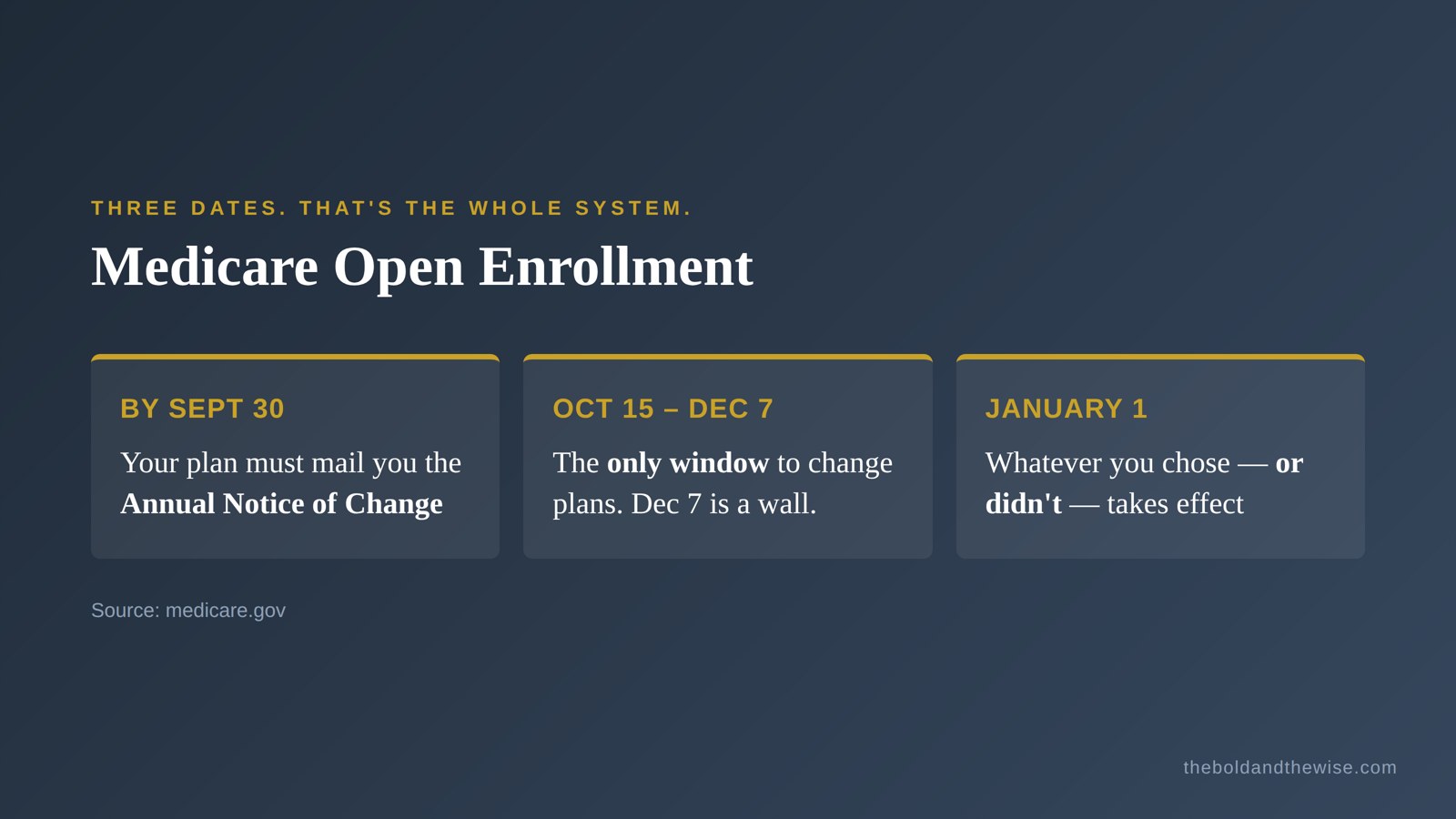
December 7 is a wall, not a suggestion. Your plan has to receive your request by that date. Miss it and, with narrow exceptions, you’re living with your choice until the following January.
There’s one partial safety net: if you’re in a Medicare Advantage plan, January 1 through March 31 you get one chance to switch to a different Advantage plan or drop back to Original Medicare. That’s a smaller door, and it doesn’t help at all if you’re in Original Medicare with a standalone drug plan.
The thirty-minute review
You do not need to become an expert. You need to answer five questions, and the envelope contains four of the answers.
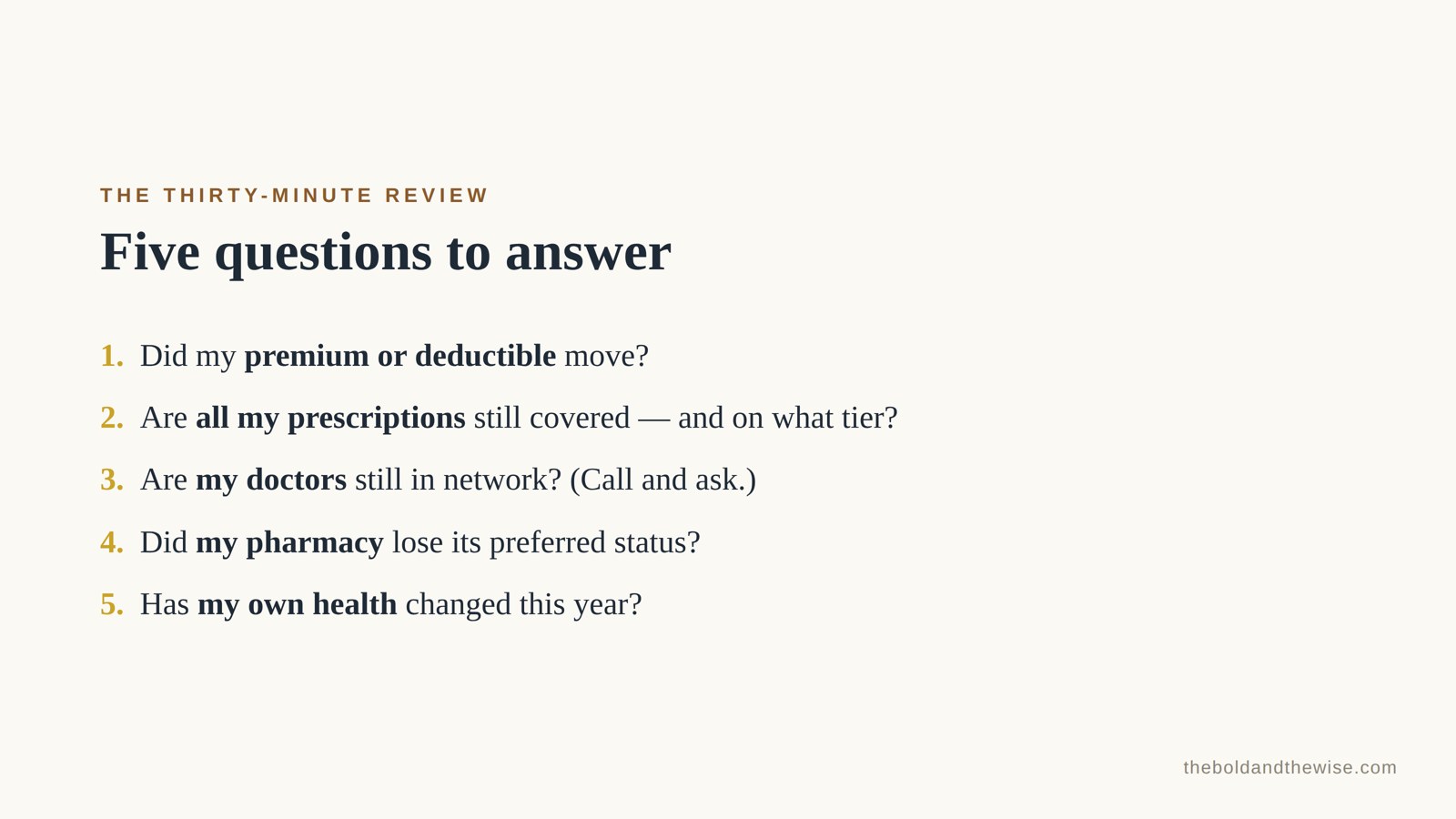
1. Did my premium or deductible move? Look for the side-by-side “this year / next year” table, usually near the front. Note the difference and keep reading — a premium can drop while everything else gets worse, which is precisely how a plan is designed to look attractive.
2. Is every one of my prescriptions still covered? This is the one that matters most, and the one people skip because it’s tedious. Get your actual pill bottles out. Put them on the table. Check each against the plan’s drug list, and check the tier — a drug can stay covered while moving to a tier that costs four times more. Look for prior authorization and step therapy next to your medications too; both mean new paperwork and delays before you can get what you already take.
3. Are my doctors still in network? Networks change every year. Don’t trust last year’s answer, and don’t trust the plan’s online directory alone — those directories are notoriously out of date. Call the doctor’s office and ask them directly whether they’re taking that plan next year.
4. Did my pharmacy change status? Many plans have “preferred” pharmacies where your costs are lower. The same drug at the same tier can cost meaningfully different amounts at the drugstore on your corner versus one three miles away. This changes yearly, and nobody announces it.
5. Has my own health changed? This one isn’t in the envelope. If you started a new medication this year, had a procedure, or got a new specialist, the plan that fit you last October may not be the right shape for the person you are now.
Answer those five and you’ve done more due diligence than most people manage in a decade.
Doing nothing is itself a decision — just one made on your behalf, by a company, in its own interest.
Two warnings

The phone is going to start ringing on October 1, and it will not stop until December. Some of those callers are legitimate licensed agents. Some are not. The rule that will protect you almost every time: Medicare will never call you out of the blue to sell you a plan. Anyone who does is selling, not helping, and anyone who pressures you to decide on the call has told you everything you need to know about them. You can hang up. You are allowed to hang up.
And “I’ll do it in November” is how people miss it. The window is eight weeks and it runs straight through Thanksgiving, which is exactly when a family absorbs everyone’s attention. Put it on the calendar for the third week of October and treat it like a doctor’s appointment.
Where to get real help, free

This is the part I most want you to keep.
Every state has a State Health Insurance Assistance Program — SHIP. Trained counselors, free, and here’s what makes them different from every other voice you’ll hear this fall: they don’t sell insurance and they don’t earn a commission. They have no stake in what you choose. Sit down with one, bring your pill bottles and your notice, and you’ll get an hour of genuinely disinterested help.
Find your state’s program at shiphelp.org, or call 1-800-MEDICARE (1-800-633-4227) and ask for your state’s SHIP.
You can also run your own numbers at medicare.gov/plan-compare — enter your medications and your pharmacy and it will show you total estimated yearly cost across plans, which is the only number that means anything. Comparing premiums alone is how people talk themselves into worse coverage.
The last word
I know it’s boring. I know the envelope is ugly and the tables are dull and there are eleven better things to do with a Tuesday evening.
But this is one of the few places in life where thirty focused minutes reliably returns hundreds or thousands of dollars, and where doing nothing is itself a decision — just one made on your behalf, by a company, in its own interest.
Go get the envelope out of the recycling. It’s probably still in there.
Go be bold!
New to how the parts fit together? Start with Medicare, Explained Once and Properly.
Put one date in your calendar right now: the third week of October, thirty minutes, pill bottles on the table. That’s the whole assignment. Leave a comment and tell me you did it.