
The Six Weeks That Decide Your Year
This article is for general information and is not legal, tax, or insurance advice. Coverage rules change and individual situations differ — verify details at Medicare.gov or with a licensed counselor before you make a decision.
There is a six-week window opening in two weeks that will quietly set the price of your health for the next twelve months, and most people are going to sleep through it.
October 15 through December 7. That’s Medicare Open Enrollment. Whatever you do — or don’t do — in those six weeks takes effect January 1 and generally locks in for the year.
Here’s the part that bothers me. The default option is doing nothing, and doing nothing renews you automatically. That feels like safety. It isn’t. It’s an agreement to accept whatever your plan changed while you weren’t looking — a new deductible, a new tier for the drug you’ve taken for nine years, a pharmacy that’s no longer “preferred,” a doctor who quietly left the network. The plan you chose in 2024 is not the plan you have in 2027. It just has the same name.
I wrote earlier this month about the annual notice that arrives in a plain envelope in late September — the one everybody throws away. This piece is the next step: what to actually do with those six weeks. Not the theory. The work.
What you can change, and what you can’t
During Open Enrollment you can:
- Switch from Original Medicare to a Medicare Advantage plan
- Switch from Medicare Advantage back to Original Medicare
- Switch from one Medicare Advantage plan to another
- Join, drop, or switch a Part D drug plan
One rule that catches people every year: your plan has to have your request by December 7. Not postmarked December 7. Not “I called and left a message on the 7th.” Received. If you are working up to the deadline, enroll online or by phone and write down the confirmation number.
And if you change your mind in January, you are not entirely stuck. The Medicare Advantage Open Enrollment Period runs January 1 through March 31. If you’re in a Medicare Advantage plan, that window lets you switch to a different Advantage plan or drop back to Original Medicare. It does not let someone on Original Medicare jump into an Advantage plan. It’s an exit door, not an entrance.
The four numbers that decide everything

Most people compare plans on the premium, because the premium is the number printed largest. The premium is the least important of the four.
1. The monthly premium. What you pay to have the plan. Fine. Note it and move on.
2. The deductible. What you pay before the plan pays. For Part D drug coverage there’s a legal ceiling: the maximum deductible a plan can charge is $700 in 2027, up from $615 this year. Some plans charge zero. Same drugs, same pharmacy, $700 of difference before coverage even starts.
3. Your actual drugs on that plan’s formulary. This is the whole ballgame, and I’ll come back to it.
4. The out-of-pocket cap. This is the number that changed everything, and it is criminally under-discussed. Part D now has a hard annual limit on what you pay out of pocket for covered prescriptions: $2,400 in 2027, up from $2,100 in 2026. Once you hit it, you pay nothing for your covered drugs for the rest of the calendar year. Not a smaller coinsurance. Zero.
If you are someone who used to fall into a coverage gap and start rationing pills in August, read that paragraph again. That cliff is gone, and it was replaced by a ceiling.
Six weeks a year, you get to choose. The other forty-six, you live with what got chosen.
The twenty minutes that actually matter
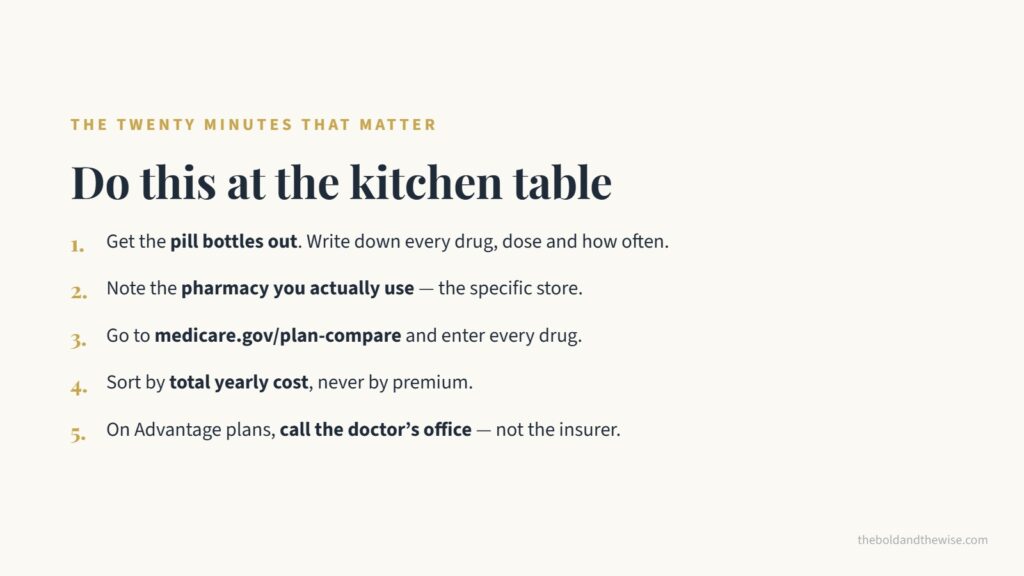
Here is the work. It is not complicated, and almost nobody does it.
Write down every prescription you take. Drug name, dose, and how often. Get the bottles out and read the labels — don’t do this from memory. Add anything you take seasonally.
Write down the pharmacy you actually use. Not the chain. The specific store, and whether you’d use mail order.
Go to Medicare’s Plan Finder at medicare.gov/plan-compare. Enter your ZIP code and then enter every drug on your list. The tool will show you the plans available to you with your drugs priced in, and it will sort by estimated total yearly cost rather than by premium. That’s the number you want. A plan with a $0 premium and your blood thinner on tier 4 can cost you two thousand dollars more over a year than a plan with a $40 premium that has it on tier 2.
Check two things the tool won’t shout at you about. Is your pharmacy in that plan’s preferred network, which is a different and cheaper thing than merely being in-network? And does the drug require prior authorization or step therapy — meaning you have to fail a cheaper drug first before they’ll cover yours?
If you’re looking at Medicare Advantage, call the doctor’s office. Not the insurance company. Call the front desk of every physician and specialist you intend to keep and ask, by name, whether they will be in that specific plan for next year. Provider directories are famously out of date. The receptionist knows the truth.
Two programs worth knowing by name
The Medicare Prescription Payment Plan. This one is newer and still poorly known. It lets you spread your out-of-pocket prescription costs across the calendar year in monthly payments instead of absorbing them at the pharmacy counter as they land. It doesn’t lower what you owe — it changes the shape of it. If you have a single expensive drug that hits you hard in January and February, this is worth a phone call.
Extra Help. A federal program that helps pay Part D premiums, deductibles, and copays for people with limited income and resources. Plenty of people who qualify never apply because they assume they earn too much. It costs nothing to find out, and you apply through Social Security.
Where to get help that isn’t selling you something

This matters, so I’ll be blunt about it. The person who calls you in October offering to “review your Medicare options” is usually paid a commission on what you sign. That doesn’t make them dishonest. It does mean they are not neutral, and they may only represent a handful of carriers.

Two sources are free and not paid on your decision:
- Your State Health Insurance Assistance Program (SHIP). Trained counselors, one-on-one, no products to sell. Every state has one, and you can find yours at shiphelp.org.
- 1-800-MEDICARE (1-800-633-4227). The representatives can run your drug list against available plans with you on the phone.
Use one of them. Then, if you want a broker’s help, you’ll be walking in already knowing what good looks like.
The honest bottom line
I’m not going to tell you to switch plans. Plenty of people compare carefully and conclude that what they have is right, and that conclusion is worth just as much as a change — because now it’s a decision instead of a default.
What I’m telling you is that six weeks a year is when you get to decide, and the rest of the year you live with what was decided. An afternoon at the kitchen table with your pill bottles and a laptop is the highest-paid hour of work available to you between now and Christmas.
Put it on the calendar. October 15. The bottles, the laptop, and a pot of coffee.
Go be bold!
If this was useful, subscribe so you don’t miss Monday, Wednesday, or Friday — and forward it to somebody who’s about to renew without looking.
Sources
- Medicare.gov — Joining a plan
- Medicare.gov — Part D costs
- Medicare.gov — Medicare Plan Finder