
The Room Got Louder
I’m not an audiologist and this isn’t medical advice. Some hearing changes are signs of conditions that need a physician, not a device — sudden hearing loss in particular is treated as a medical emergency. The red-flag list is in the article. If any of it describes you, see a doctor before you buy anything.
It never announces itself. That’s the thing about it.
There’s no morning where you wake up and discover you can’t hear. What happens instead is that the world quietly rearranges itself around a problem nobody has named, and the rearranging looks like ordinary preference.
You stop suggesting the Italian place, because the Italian place is loud. You start letting your spouse take the phone calls — she’s better at it anyway. At the family dinner you laugh a beat after everyone else, which works fine. You drift toward the end of the table. You find that you’d rather stay home, honestly, and you have a perfectly good reason for it that has nothing to do with your ears.
Then somebody says something about the television volume and you get irritated, and you don’t entirely know why.
How common this is, and why it doesn’t feel common
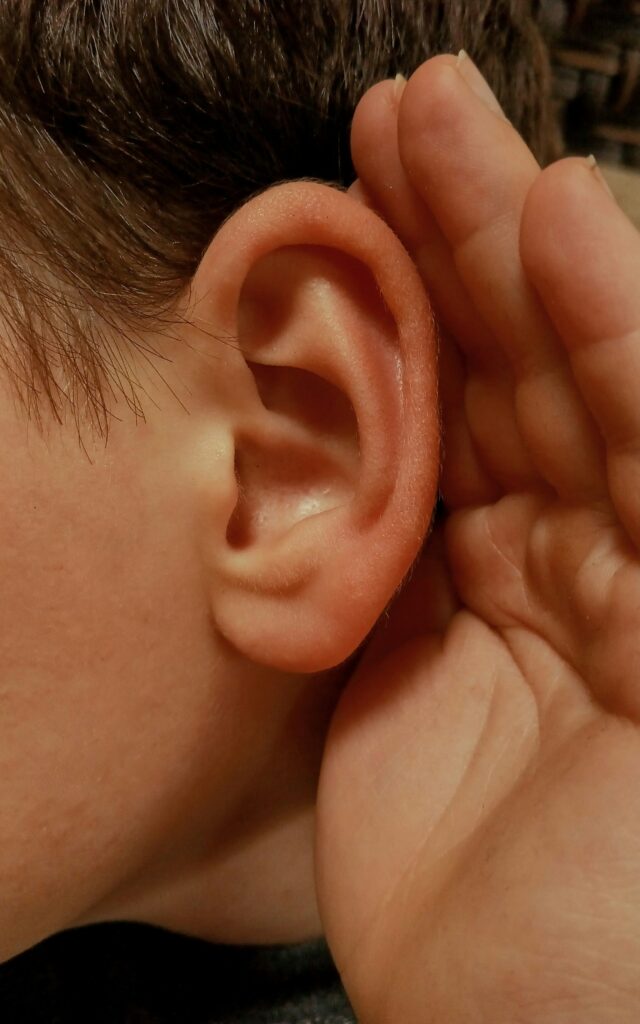
About one in three Americans between 65 and 74 has hearing loss. For people over 75, it’s nearly half.
Sit with that a second. In any room of your peers, a third of the people are managing this, and almost none of them are talking about it. The condition is nearly universal and the conversation is nearly nonexistent — which is exactly the combination that makes people feel like it’s a personal failing.
Age-related hearing loss — presbycusis is the clinical name — usually comes on gradually and usually in both ears at once. That symmetry is precisely why it hides. If it happened in one ear you’d notice immediately. Happening evenly, on both sides, over years, it just feels like the world changed.
The causes are a stack, not a single villain: structural changes in the inner ear, changes in the nerve pathway to the brain, a lifetime of noise exposure, high blood pressure and diabetes, certain medications, and plain genetics.
And it has a signature. The high frequencies go first — which is why this isn’t really about volume. Consonants live up high. S, f, th, sh, k. Vowels live low and come through fine. So the sentence still arrives, just with the edges filed off, and your brain fills the gaps from context. In a quiet kitchen it fills them perfectly. In a restaurant with music and forty people, it can’t, and you get exhausted trying.
That’s the real experience of early hearing loss, and it is almost never described as “I can’t hear.” It’s described as “I can hear you, I just can’t understand you.” If you’ve ever said that sentence, that sentence is the diagnosis.
“I can hear you, I just can’t understand you.” If you’ve said that sentence, that sentence is the diagnosis.
What it costs beyond the hearing

I want to be careful here, because this is territory where people oversell, and you deserve the honest version.
What’s clear is the social cost, and it’s heavy. Untreated hearing loss pulls people out of conversation, and out of conversation means out of the room. That path — restaurants, then gatherings, then invitations that stop coming — is well worn and runs toward isolation, which carries real consequences of its own for older adults.
There’s also an active area of research connecting hearing loss to cognitive decline, and a large trial in recent years found hearing treatment slowed cognitive decline in older adults who were already at higher risk. That’s a meaningful finding. It is not a promise that hearing aids prevent dementia, and anybody selling you one on that basis is getting ahead of the evidence.
Here’s the argument that doesn’t require any of that research, and it’s enough on its own: you are missing your grandchildren’s sentences. Not the gist — the sentences. That’s the cost, and you’re paying it every week.
The thing that changed, and most people missed it
For most of your life, hearing aids meant an appointment, an exam, a fitting, a professional, and a price tag commonly in the thousands — usually not covered by Medicare.
In August 2022 the FDA issued a rule creating a new category: over-the-counter hearing aids, and it took effect that October. They’re for adults 18 and older who believe they have mild to moderate hearing loss. No exam required, no prescription, no fitting appointment. You can buy them at a pharmacy or online. The prices start dramatically below the traditional route, and the field now includes mainstream consumer electronics — including hearing-aid features built into earbuds people already own, which has done more to kill the stigma than twenty years of campaigns.
That rule removed the two barriers that actually stopped people: the cost and the errand. What’s left is the third one, which is the hardest.

But there’s a list of situations where OTC is the wrong move and you need a physician first. From the NIDCD, see a doctor if you have:
- Fluid, pus, or blood from the ear in the last six months
- Ear pain or discomfort
- A lot of earwax, or the feeling something is in the ear canal
- Severe dizziness along with the hearing loss
- Hearing loss that came on suddenly or is getting worse quickly — this one is urgent, treat it as an emergency
- Hearing that comes and goes, fluctuating within the last six months
- Hearing loss in one ear only, or a big difference between the two ears
One-sided or sudden loss in particular is not a shopping problem. It’s a doctor problem, sometimes a time-sensitive one.
And OTC has a ceiling: it’s designed for mild-to-moderate loss. If your loss is beyond that, a properly fitted prescription device from an audiologist will outperform it, and it’s worth the appointment.
The third barrier
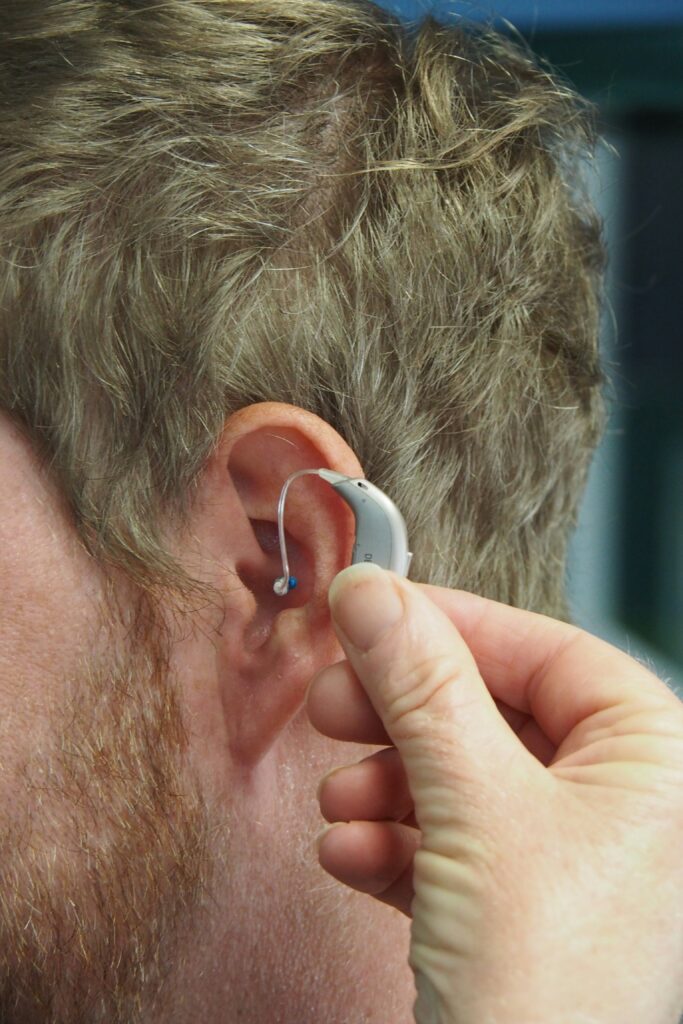
Cost and hassle are handled. What’s left is the one nobody puts in the brochure: a hearing aid means admitting you’re a person who needs a hearing aid.
I’d offer a comparison. Nobody thinks a thing about glasses. Nobody has ever once said “he’s really let himself go — look, he’s reading.” We accepted long ago that eyes change and that correcting them is unremarkable. Hearing sits in an older, dumber category, and the only reason is that nobody’s bothered to update it.
Meanwhile, the alternative is not “no device.” The alternative is a slow withdrawal from the parts of your life that happen out loud, dressed up as preference. Nobody sees that happening, including you, which is exactly what makes it work.
What to do this week
- Take a hearing test. Free screenings are widely available, several reputable app-based tests exist, and an audiologist’s full workup is the gold standard. Get a number instead of a feeling.
- Read the red-flag list above. If anything on it applies — especially sudden loss or one ear — see a physician first, not a store.
- Ask the person you live with. They’ve known for two years. Ask them plainly and then don’t argue with the answer.
- Try something. If it’s mild to moderate, the OTC route is now cheap enough that the experiment costs you very little. Check the return policy before you buy, and give it more than a day — your brain has to relearn sounds it stopped processing years ago, and the first week is genuinely strange.
The room didn’t get louder. And it’s not a moral failing that it didn’t.
Go be bold!
Do one thing before Friday: ask the person you live with whether they’ve noticed. Then reply and tell me what they said — I suspect I know.
Sources
- NIDCD, Age-Related Hearing Loss (Presbycusis) — 1 in 3 aged 65–74, nearly half over 75; causes and signs
- NIDCD, Over-the-Counter Hearing Aids — who they’re for, and the list of reasons to see a doctor first
- FDA, OTC Hearing Aids: What You Should Know — final rule issued August 17, 2022, in effect October 17, 2022, for adults 18+ with perceived mild to moderate loss